

A virtual airline.
With real operations.
Eurostarling has been running a complete airline operation as a flight-simulation platform for 11 years. We are not a logbook, not pay-to-rank, not a toy — we run a simulated scheduled operation with passengers, pricing, disruptions and real ops workflows.

Block time, not playtime.
We build the software sim pilots need to fly a real scheduled operation — and the passenger-side that makes it credible.
A line operation, not random
Summer and winter schedule, fixed slot windows, planned turnarounds. If a flight runs today, it ran yesterday and will run tomorrow.
Real passengers, real inventory
Every flight has real load factors, seat assignments, fare classes and pricing logic. You do not fly an empty sky — you fly a full aircraft.
Free, voluntary, no pay-to-rank
Eurostarling is a passion project. It costs nothing, there is no captain-stripes shop, and rank comes from logged block time only.
Two hubs. Two brands. One network.
Munich (EDDM) has been our operations base since 2017 and remains the larger of the two hubs — 120 destinations against 101 from Berlin: Europe, long-haul to Asia and the African routes all run from there. Berlin Brandenburg (EDDB) joined when the airport opened — the company is registered here, and the entire American continent departs from here, from Canada down to South America. balejet serves the Swiss market from bases in Geneva and Basel. On top runs a direct programme out of Frankfurt, Stuttgart and Hamburg that skips the hubs entirely.
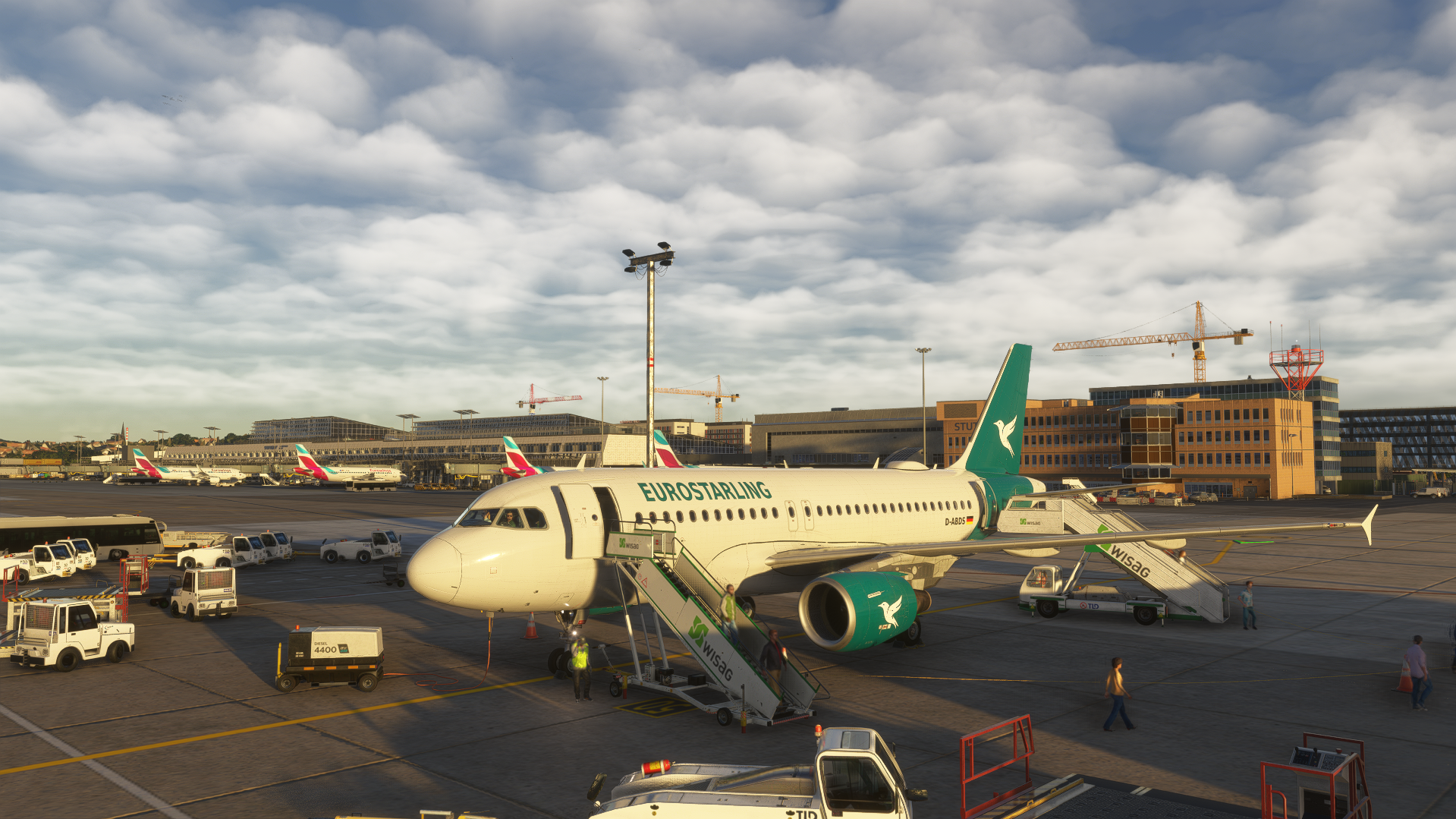
A full schedule runs in the background.
While you sit in the cockpit, the entire operational stack keeps running: passengers book around the clock, prices rotate by season and load factor, ACARS evaluates every landing, the OCC reacts to delays, and the next line flight is generated automatically.
Real bookings
Sim passengers buy tickets, baggage, seats. Your load factor comes from real inventory — not a random generator.
Dynamic pricing
Prices respond to load, date, season, pax mix and fare class. Fuel surcharges, airport charges and country taxes are shown separately — no net-price myth.
Cargo, baggage & loadsheet
Belly cargo with AWB, physical bag tags from check-in to delivery, loadsheet with real pax masses (EASA M/F split) and tail-specific weights. SimBrief gets an honest zero-fuel weight.
Disruptions, OCC, recovery
A delayed flight cascades into connections, crew rosters and inventory. The OCC manages slots and recoveries — you are part of that operation.
Self-service pax
Passengers check in 24h ahead, buy seat upgrades, book ancillaries from 13 categories, rebook themselves after disruptions — all without crew intervention.
Economics & costs
Every flight is costed against fuel (hedged), crew, maintenance, de-icing, catering, airport charges, marketing and loyalty. What is left is margin — no magic.
11 years. Two moves. One principle.
We started in Stuttgart with two aircraft and six destinations. By far the largest part of what is in the schedule today was built in the last five years — aircraft ordered before the routes existed, and routes that had to wait for their aircraft.
-
2015
Two aircraft in Stuttgart
It began as a piece of arithmetic. Anyone flying from Baden-Württemberg into Europe went via Frankfurt or Munich and lost half a day doing it. We flew direct with two A319s. Six destinations, fixed departure times, the same every day.
-
2016
ESG in the published schedule
Registered as “ESG”, first published summer season: nine aircraft, fourteen destinations. From here on it was no longer occasional flying but a schedule you could book against.
-
2017
The move to Munich
Stuttgart was the right start and the wrong size — one runway, tight night restrictions, no room for a hub. Munich had both, and that year capacity came free in the German market that needed an operator quickly. We took it: twenty aircraft by the year’s end, and a first morning bank built for connections rather than single flights. Operations have stayed there ever since.
-
2018
balejet joins
Switzerland is not in the EU — running scheduled services from there requires an operating licence of your own. Rather than spend years applying for one, we bought one: balejet, at the time a small holiday carrier out of Basel. The name stayed, lower-case as it always was, and with it the Swiss AOC. balejet still runs its own programme out of Geneva and Basel; the hub services into Zurich, Geneva and Basel are flown by Eurostarling itself.
-
2019
Europe complete
More than 80 destinations from Munich, the A320neo as the standard type. For the first time a winter schedule of its own instead of the same frequencies all year — ski destinations in winter, islands in summer.
-
2020
Berlin gets a hub
When BER opened, Europe’s last major capital without a hub finally had an airport that could carry one. We took the opportunity: Berlin became our second hub and our registered seat. The build-up ran straight into the pandemic, with the schedule down to a third at times. Operations stayed in Munich — and still are there today.
-
2021
One fleet, one family
Full harmonisation on Airbus, plus the A220-300 for the thin routes where a larger type would have gone out half empty. For operations that means one maintenance line and one type rating. For you it means the same cabin, the same seat pitch, the same on-board systems — whichever route you book.
-
2022
Fares that sit in the table
A move to fare families where the inclusions sit in the table, not in the small print. Alongside it, the frequent flyer programme with separate status and award miles — and the counter that comes to you: check-in 24 hours before departure, boarding pass as a PDF, self-rebooking after a disruption with no phone call and no queue.
-
2023
Across the Atlantic — from Berlin
The A330-900 and A350-900 join the fleet. The first long-haul route starts in Berlin by design: nobody flew the Atlantic from there, so travellers had to route via Frankfurt or Amsterdam. New York first, Washington and Chicago in the same season. Lie-flat Business, Comfort as a new cabin in between. Far more was on order than could fly that year — the deliveries spread across the three seasons that followed, and with them everything else on this list.
-
2024
Munich goes intercontinental
Singapore, Delhi, Nairobi, Tokyo and Shanghai from Munich, Los Angeles and Vancouver from Berlin. The demand in the south had been there all along — it was simply routing through other people’s hubs. With that, each hub had a long-haul direction of its own: Berlin the North Atlantic, Munich Asia and Africa. Ten intercontinental destinations, and exactly one widebody for each of them.
-
2025
The order arrives
The year the fleet grew faster than the schedule. Berlin builds North America from five destinations to fifteen — Boston, Miami, Seattle, San Francisco, Dallas, Houston, Atlanta, plus Toronto, Montreal and Mexico City. Munich deepens Asia rather than widening it: Seoul, Osaka, Hong Kong, Bangkok, Taipei, Kuala Lumpur, Mumbai, Bangalore and Beijing. A hub does not gain from more destinations but from more departures that fit together — that was the real work of the season.
-
2026
The summer schedule where it all lands
South America from Berlin — Buenos Aires, São Paulo, Santiago, Bogotá and Lima — plus the African routes from Munich to Addis Ababa, Lagos and Johannesburg. Berlin no longer carries the North Atlantic but the whole continent. As things stand: 247 Airbus, 154 destinations across 66 countries, 37 of them intercontinental. Munich has remained the larger hub at 120 destinations; Berlin, at 101, has all but caught up on a three-year head start.
How the VA works technically
StarlingPulse, OCC, tech stack, onboarding process. Everything about the operations side and the crew career path.
See VA functionsDestinations and routes
All destinations at a glance — non-stop on the active schedule, grouped by continent.
See destinations